
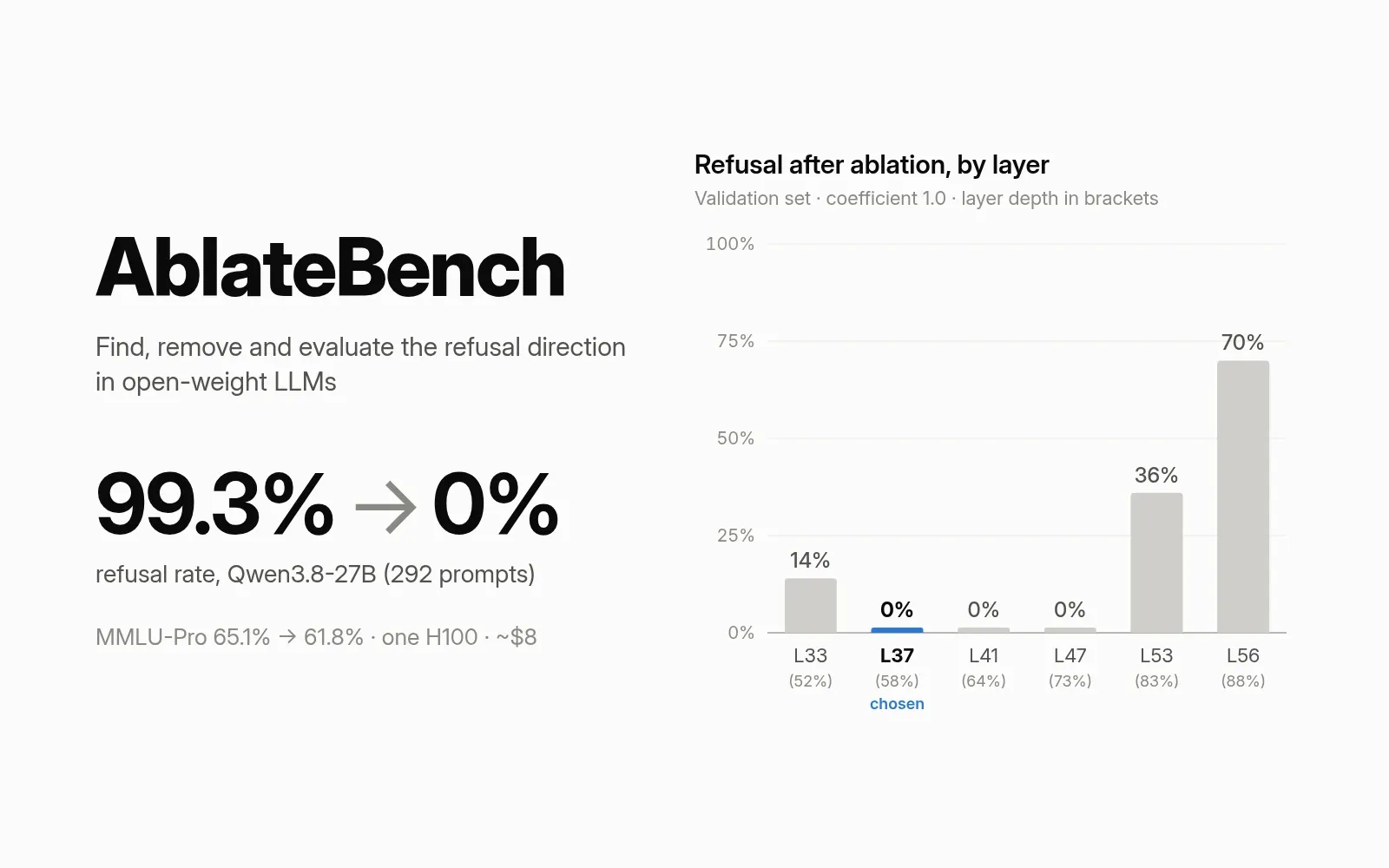
AblateBench
AblateBench is a complete pipeline to find, remove, and evaluate the internal “refusal direction” in open-weight large language models — a technique known as abliteration.
It reproduces the difference-in-means technique from Arditi et al. (2024) and wraps it in a self-built evaluation harness that measures not just whether refusals go away, but what the edit costs in model capability. All GPU compute runs on rented GPUs via Modal.
Released model: rajaykumar12959/qwen3.8-27b-abliterated — refusal 99.3% → 0.0%, MMLU-Pro 65.1% → 61.8%.
Key Features
Direction Extraction & Ablation
- Difference-in-Means Directions – Computes a per-layer refusal direction from harmful vs. harmless prompt activations
- Gram-Schmidt Purification – Filters generic “a prompt was given” signal out of the refusal-specific direction
- Two Ablation Methods – A reversible runtime hook and a permanent weight edit, tested to be numerically equivalent
- Layer/Coefficient Sweep – Picks the operating point on the refusal-vs-capability tradeoff curve instead of guessing
Evaluation Harness
- Two-Tier Refusal Grader – Rule-based classification with an LLM-judge fallback for ambiguous responses
- Independent Capability Guard – ARC-Easy as a quick sanity check, plus MMLU-Pro and harmless-prompt KL divergence
- 12-Category Eval Set – 292 category-labeled prompts for measuring refusal behaviour
Architecture Coverage
- Llama & Qwen2.5 – Standard decoder architectures
- Qwen3.5–3.8 Hybrid Models – Edits linear-attention output projections that a naive edit would miss
- Gemma 2/3 Sandwich-Norm Models – Norm-aware orthogonalization, with tests that fail on the naive edit
Results
Qwen3.8-27B
Purified direction from layer 37 of 64, coefficient 1.0, run on a single H100 for ~$8 of Modal compute.
| Metric | Original | Abliterated |
|---|---|---|
| Refusal rate (292 prompts, 12 categories) | 99.3% | 0.0% |
| MMLU-Pro (490 questions, 14 subjects) | 65.1% | 61.8% (−3.3pp) |
| KL divergence on harmless prompts | — | 0.086 nats |
| ARC-Easy (100 questions) | 1.000 | 1.000 |
Key Insights
- Purification matters – Gram-Schmidt orthogonalization adds ~15pp of refusal suppression on Qwen2.5-7B at no capability cost
- Layer selection is dominant – The winning layer transfers by relative depth (~57–58%) across model sizes
- Easy benchmarks hide the cost – ARC-Easy reads 1.000 before and after; MMLU-Pro reveals the real 3.3pp drop
How It Works
- Prepare data – Builds harmful/harmless prompt sets and a capability MCQ subset on a shared Modal Volume
- Extract directions – Runs one forward pass per prompt and computes a per-layer refusal direction
- Sweep – Tests candidate layers across coefficients, grading refusal and capability
- Full pipeline – Runs baseline, runtime-hook ablation, and permanent weight ablation at the winning operating point
- Benchmark – Measures MMLU-Pro accuracy and harmless-prompt KL divergence against the base model
- Publish – Reshards the edited checkpoint and pushes it to the Hugging Face Hub
Tech Stack
Core
- Python 3.11 – Pipeline and evaluation code
- PyTorch – Activation extraction, hooks, and weight edits
- Transformers – Model loading across Llama, Qwen, and Gemma families
Infrastructure
- Modal – Serverless GPU orchestration (H100 / B200)
- Hugging Face Hub – Model and dataset access, checkpoint publishing
Testing
- pytest – 60 CPU-only unit tests, including architecture tests on tiny random models
Project Goals
- Make abliteration reproducible and measurable, not a one-off trick
- Quantify the capability cost of refusal removal with benchmarks hard enough to show it
- Support modern hybrid and sandwich-norm architectures correctly
- Keep GPU runs cheap and predictable through bounded sweeps